Showing posts with label Coming of Age Fiction. Show all posts

Tuesday, March 12, 2013

The Fellowship of the Mothership

Mothership
Author:
Martin Leicht and Isla Neal
Publisher:
Simon & Schuster (2012)
Number of Pages:
308
Review: “Really, for all the poetry in the world on the subject, when you get right down to it, it's mostly just boom! penis vagina.” What’s so funny about a school for pregnant teenagers? Well when you place the school in outer space and have a main character that is as sarcastic and witty as Elvie Nara… simply put: everything!!
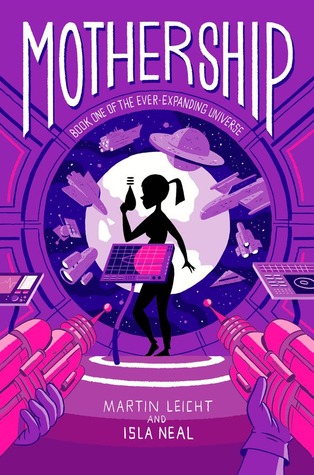
Elvie Nara was just your typical teenager until she made the mistake of doing the horizontal limbo with the new hottie in school Cole Archer. To her surprise she found herself pregnant and when she told the dumb as a brick Cole he was going to be a father he skipped town, presumably never to be heard from again.  Her father decides that the best option for her is to attend the Hanover School For Expecting Teen Mothers, the only thing is, it’s in outer space. As if that isn’t bad enough, once she boards the ship she finds herself in the company of Britta (who didn’t need hormones to be bitchy) Coles girlfriend, and a slew of other weird characters. When the ship is invaded by this weirdo army commando, the girls find out their teachers as well as their boyfriends are not quite who they thought them to be.

I cannot write how much I loved this novel. Nothing I say could ever bring it justice but I shall attempt to do it justice. First let me say that it was the single most hilarious piece of literature I read in 2012 and probably my most recommended book. I haven’t laughed out loud (no really I let go of some unhealthy guffaws during this novel) as much as I did during this book than any I’ve read recently.  Elvie was such a dry, sarcastic and witty character I immediately fell in love with her. She reminded me of Juno and I think that’s why I loved her so much.

Elvie is different from your typical YA heroine. She starts off the novel pregnant. Yes people, she is not a virgin (insert gasp here). YA tends to villainize its non-virginal female characters, the male leads are almost always “experienced” but the females for some reason haven’t even had a proper kiss, which is why I found it so refreshing and unique to have the heroine be a non-virgin right off the bat. But aside from Elvie being Hymanally absent it was her personality that got me, and kept me reading. She is hilarious, more than hilarious! She’s mean, conniving, sarcastic, cynical, but there’s this vulnerability and loving side of her that makes her so human and real. Reading her story was like reading a person’s journal, you know if they were in space or whatever. If Jane Austin was a pregnant teenager living on a space ship in 2079 she would be Elvie Nara.

I loved the rivalry between Elvie and Britta; I also loved the fact that they both shared the same baby daddy. I mean we all know that Cole is hot but what are the chances he’d knock up two chicks at once? Well a very good chance considering Cole isn’t really a normal human boy.  Thus the disappearing act in the beginning of the novel. Cole’s love for Elvie and his affection for his children almost make you forgive him for neglecting them (and deceiving them). I also loved the fact that the authors didn’t dumb down their female characters. These girls were strong, fierce and ready for anything that came their way.

But my favourite character of all has got to be Elvie’s dad who has a solution for everything I mean how can you not love a man who is so prepared for anything he has a folder entitled "Folder three, scenario four: going into labor during a high-speed chase with extra-terrestrials.” Talk about a man who plans!

The plot is so much fun. There are not a lot of novels out there where you can say you had legitimate fun reading, but this novel it’s fair to say fun is in every atom of ink on the page. The commando takeover of the ship, the alien invasion, the sheer love between Elvie and her father, the love Cole shows his baby mamas, and every single strange, weird and hilarious scenario Elvie and the crew find themselves in makes this book my favourite read of 2012.

So if you haven’t done so yet I suggest you check out Mothership as soon as possible. It doesn’t seem to be as popular as the other books in the YA genre but search it out online from sites like Book Depository or Chapters Online. I really recommend this book and think that if you enjoy weird and sarcastic humour you will most definitely appreciate this jem of a novel.

Happy reading!

Monday, March 11, 2013

We Are All Ugly

Uglies


Author:
Scott Westerfeld
Publisher:
Simon Pulse 2005
Number of Pages: 
425
Review: “What you do, the way you think, makes you beautiful.” What negates beauty? Is it our perceptions that we imply upon others? Is it ingrained upon us from childhood? Is it socially instilled within ourselves or something that is essentially one’s own and no one else’s? But more importantly can we use beauty to control the emotions and actions of other peoples, or on a greater scale, a whole country? These are the questions that Scott Westerfeld asks in his novel called Uglies.

Uglies takes place in a futuristic earth where humans are grouped into five categories: Littlies, Uglies, New Pretties, Middle Pretties and Cumblies. Uglies pretty much look like humans from the 21st century. Flawed, different, unique; and taught at a young age that everyone deserves to be pretty, every ugly at the age of 16 will go through a series of surgeries to make them pretty. Tally is just a few months away from becoming a New Pretty when she meets Shay, the rebellious and adventurous new friend who’s also waiting to become a Pretty but unlike Tally, she is not looking forward to the surgery. On the day before her scheduled surgery, Shay decides to run away begging Tally to go with her. When Tally refuses and goes in for her surgery she’s given an ultimatum: Find Shay and expose the Ugly Society called The Smoke or remain Ugly forever. Tally must make a decision, one that will alter her future forever.

I must admit I didn’t like the first half of Uglies. In fact I hated it.  It wasn’t the concept that I hated but Tally. Talk about your typical shallow female. She complained all the time about her flaws, other people’s flaws and then I realized, of course she was complaining, she lives in a society that calls normal people UGLY! When I got over the fact that she’s supposed to be shallow I started to warm up to the story, by the time Tally got to the Smoke, I loved it.

Tally is smart. She knows wrong from right, yet she lives in this society that makes decisions for her. When Shay comes along and shows her a life that is beyond the ugly/pretty boundaries she begins to open her mind to the fact that perfection isn’t always perfect. She’s a strong female character. Once she’s out of the ugly mindset she’s not afraid to be herself, and she’s not afraid to embrace the beauty of the people around her and of her own beauty. I loved how she developed from a little girl to a strong independent young lady.

In terms of the other characters, Shay was a great ally and sometimes enemy of Tally. The rivalry between the two as well as the friendship and love they have for one another makes the characters realistic. Yes they are best friends but even best friends fight. As for the main love interest, I like the fact that it wasn’t instalove. This relationship was a slow development. I felt that David was a good match for Tally, he challenged her, and fought with her beliefs, and let her make her own decisions. He was never pushy with his beliefs and she was respectful of his opinions as well. Where Shay gushed over David, Tally actually listened to what he had to say. I liked that contrast between the two friends.

The plot was interesting. To be able to control a whole population by telling them they’re ugly and they have to look a certain way in order to feel accepted is not too far off from where our society is heading now. Everywhere we go we are constantly bombarded with advertisements, movies, even books that say we have to look a certain way in order to have fun, get a mate and live a full wealthy life. More and more people are opting for Plastic Surgery these days, if we could somehow get that kind of extreme surgery for free I’m pretty sure the number of plastic surgeries performed per year would sky rocket. This false sense of happiness can be used against us into making us do things we really don’t want to do after all.

Scott Westerfeld really put a lot of great plot twists and ideas in this novel.  The Uglies society is something we should pay close attention too because the way society is shaped upon looks these days this may very well be our future if we’re not careful and don’t show people that everyone is beautiful in their own way.  I highly recommend you checking out the first book in this series and I plan on continuing with it in my future reads.

Happy Reading!

Thursday, January 6, 2011

The Publicly Loved (But Secretly Annoying) Book


Author: 
Shilpi Somaya Gowda
Published:
Harper Collins (2010)
Number of Pages: 
342
Review:
“Adoption only solves childlessness not infertility.” Celebrities make adoption look like a breeze. You go to a foreign poverty stricken country, point to the child you want and within a few weeks that child is yours. What the public fails to see is the struggle parents have bonding with the child. It isn’t easy to be a parent in the first place, imagine being a first time parent to a child who doesn’t look like you and worse of all who doesn’t respond to you. But what about the biological parents of this child? Are they really so heartless that they can give up their baby or is there no choice in this decision? Perhaps giving the child away is much more advantageous to the child then it is to selfishly cling to the kid and bring them up in that poverty stricken world. However, this sense of loss and abandonment can haunt the parents for the rest of their lives. These are the dilemmas that surround the story of Secret Daughter.


In rural India Kavita and her Husband are expecting their second child, a child that Kavita both loves fiercely and fears, for if this child is a girl her husband is sure to do something drastic. Across the ocean, Somer and her husband wait patiently at the gynaecologist’s office hoping to hear that after suffering through several miscarriages that she’ll be able to try reproducing again; only instead of hearing good news Somer learns that her ovaries have stopped producing eggs and that although she is only in her 30s she never going to give birth. Kavita gives birth to a beautiful baby girl, a girl she had no hope of keeping, so she gave up the child for adoption rather than have her husband kill this one as he did the other. Somer adopts Kavita’s baby and struggles to find that bond so many mothers have instantly with their children. Although separated by an ocean these two women both struggle with the same issues when it comes to raising a family and find themselves to be connected by a little girl named Asha.

The power of a mother’s love is present in every letter of this novel. The things women will do for their children are devastating, unforgiving, unconditional, and overwhelming. I have so much more appreciation for my mother after reading this novel. Where Kavita smothers her only remaining child with love because of regrets and a feeling of loss, Somer smothers her child because of her fear of a dream, a dream burning within Asha to find her biological family.  Somer fears that if Asha does find her biological family she will lose Asha forever, a fear with which many adoptive mothers probably live.

When I was reading this novel I had a lot of resentment towards Somer. She married into an Indian family (her husband Krishnan is Indian) but she never allowed herself to embrace his culture. In fact she repressed her husband from expressing his culture. I found this very American idea of assimilation to be insulting to me who was born in Canada but still maintains a very South American culture. It wasn’t until I got another prospective that I started to realize my initial hatred for Somer was unnecessary. In truth Somer never got the chance to embrace the culture because her husband never showed her what being Indian was like. He immediately changed his ways of living the minute he stepped on American soil. He gave up every part of him that was Indian and showed Somer that he was indeed American. It wasn’t until he went back to India that he did a complete 180 and changed into someone Somer couldn’t even recognize and what’s worse: he didn’t even educate Somer about his culture. It was complete culture shock that damaged Somer and made her resent her Indian husband and later her Indian daughter.

Another thing I found to be annoying was the fact that the men really didn’t have much of a voice in the novel. Jasu (Kavita’s husband) the hard working husband of Kavita was often seen as the bad father who was trying to mend his ways. Krishnan was the one suppressing who he really was, always with a bottle of hot sauce to pour over his bland food as if it’ll spice up his bland life, and Vikram, the son of Kavita and Jasu, who although growing up in such horrible conditions and then finds himself settling into a life of crime doesn’t even have a say in the novel, in fact by the end he’s pretty much a forgotten memory. 

One thing I really liked though was the symmetry of India. The reader through Kavita got to see India in a very negative disgusting light. Living in the slums of Mumbai, the lack of proper housing, corrupted legal forces, and crime knocking on every door all of these situations were replaced when Asha arrives in India with the splendour of Indian weddings, the amazing tastes of the cuisine, and the glamorous clothing and houses.  The two sides of this country were portrayed with a beautiful sadness.

Perhaps if Gowda had focused a bit more on Somer and less on Kavita I’d have warmed up to Somer more than I had; this was probably one of the more major flaws of the novel, the fact that the author spent so much of it focused on Kavita and her struggles the other characters are often left as a side story, or insignificant. I’d have also enjoyed it more had the men been given a stronger voice. Yes this is a story about strong women, but I felt the men to be neglected, supporting characters that weren’t really supporting. However the novel was emotionally poignant and beautifully so. Her writing was easy to capture your attention. The novel captures what it means to be a mother but more importantly it captures what it means to be a family.

Happy Reading!!!

Sunday, December 19, 2010

A Tale of Sex, Birth, Love and Pain

The Birth House

Author:
Ami McKay
Published:
Knopf Canada (2006)
Number of Pages:
400
Review:
What started out as a fun Autumn read turned into an enlightening, nostalgic walk back in time. Here in the 21st century duties such as giving and aiding in birth is no longer a very feminine thing. Men are now aiding in the birth of babies and some men are even trying to have babies. The time frame that this novel takes place in is a time of innocence and strong female/male barriers. One that if crossed, the party involved would have to endure serious consequences, all of which are covered in this wonderful gem of a novel.
Set in the early 1900’s Nova Scotia in a time when women were not considered persons and feminism was an ideology away Dora Rare dares to become an independent female. An elderly midwife, Marie, takes Dora under her wing and trains her in her field of work only to leave Dora to deal with a loveless and burdensome marriage, a child left in her care after being abandoned by her parents and a university educated doctor that claims he can deliver babies “pain free.” Through birth, love, sex, and pain we see the development of a young naive child grow into a passionate feminist woman, a woman who first discovers what an orgasm is in the medical chair, a woman who joins in with the suffragette movement and a woman who had she have been living in the 21st century would probably choose the same path of life that she had lived.
Ami McKay’s The Birth House is a phenomenal piece of literature. Each sentence explodes with detail, emotion and history. Reading this book was like stepping into a journal, the narration is passionate and told by a young feminist who captures her audience with her charms, naivety, and wit. Humorous, and delightful, this colourful account of life and the collection of scrapbook type newspaper clippings to provide proof of her accounts of life leave the reader in awe of the main character: Dora.
This novel was clearly written by a strong feminist voice and it is evident in every sentence of the novel that women have a purpose in this world other than to serve men. “If women lose the right to say where and how they birth their children, they will have lost something that’s as dear to life as breathing.” McKay's Dora was a strong woman trying to live in a man’s world, a world which condemned her practise of birthing as a midwife as barbaric and immoral. Her birthing ways were passed on from generation to generation, from female to female, and was used to birth thousands of babies yet when compared to the new (man invented) way of birthing which is basically the basis of modern gynaecology, it was seen as unfashionable, dangerous and unsafe.
What I love about McKay’s novel is her approach to showing that what is old isn’t always bad; her character although facing ridicule and shame from the new doctors who claim their way of birthing is better than a midwife surpasses all of her obstacles and eventually shows the world that sometimes a man's way of running the world isn’t always the best way.
I also love the prose. It flows so beautifully from one sentence into another that it’s like watching ripples form in the ocean. It’s one of the most beautiful pieces of writing I’ve read in a very long time. So beautiful I found myself rereading certain phases and sentences. “Everything I’ve learned from Mother, every bit of her truth, has been said while her hands were moving.” This simple sentence holds so much beauty, thought and emotions that reading it could evoke the reader to cry tears of sadness or tears of joy for either emotion is very much present in this quotation. The sheer wonder of this novel lies within quotations like these. McKay’s writing is pure poetry at it’s best.
With unforgettable characters, illusive descriptive writing and historical value, McKay's Birth House is a priceless read. She has written a Canadian masterpiece that is likely to enlighten and entertain readers for years to come. I hope you decide to read this fascinating story.
Happy Reading!!!

Tuesday, December 14, 2010

A Garden To Remember

The Lost Garden

Author:
Helen Humphreys
Published:
Phyllis Bruce Books (2004)
Number of Pages: 212
Review: Across Canada today millions of civilians will share a moment of silence to honour those that have fought for our country in the countless of wars in which Canada was involved and is currently involved.  And as we remember our veterans on this day we must also honour the lives of those our country has lost as well as the common workers, the nurses, the farmers, everyone who was involved in providing our country with the freedom we all relish in. It is in their honour I chose to read and review The Lost Garden.
Written in first person narrative, the novel focuses on 35 year old Gwen Davis, the lonely horticulturist whom has never been in love, in fact she’s never had any real relationships her entire life except for her relationship with plants, books and one author’s books in particular Virginia Woolf. After hearing of Mrs. Woolf’s disappearance and in a desperate attempt to escape her loneliness and the burning city of London (during the raids of 1941) she joins the war effort, planting food for the allies and babysitting the young women appointed to help.  Her life takes a turn for the better when she discovers a lost garden and the secret behind it’s existence. She’s also able to form relationships with two of the people she meets during her journey:  the fiery life loving Jane who teaches Gwen that life doesn’t always have to be centered and balanced and the dashing young Canadian solider Raley who, while being posted at her station, opens her heart to new experiences and love.
I think what I love most about this novel is the language it portrays. It is beautifully written with poetic sensibility and lucid prose. “This is what I knew about love. That it is tested everyday and what is not renewed is lost.” The loneliness this character feels is evident in this sentence as well it speaks of her view of life: “what is not renewed is lost” as if this escape to the army is actually a way to renew herself so that she doesn’t become lost in the war that surrounds her. 
Her loneliness is evident throughout the novel, her relationship with her co-workers, her relationship with the soldiers and even her relationship with her late mother - “I wasn’t there when my mother died,” - shows how isolated she keeps herself from everyone. Even her childhood memories are thickly covered in loneliness and isolation except for the plants and the darkness with which she surrounded herself.
The garden itself is a beautiful metaphor. When she first stumbles upon it she realizes that “the garden has been purposely planted” and as she prunes, snips and replants the garden she also prunes, snips and replants her life.  As the garden grows so does she, the gardens eventual beauty is manifest in her relationships with her friends and her relationship with herself.
The author’s metaphors are some of the best I’ve read in a while: “My discovered garden are really three gardens. They are joined together, each naturally flowing out of the other. But the other two are not yet in bloom so it feels wrong to explore them until they have fully revealed themselves.” The three main characters are all evident in this quotation and Gwen’s hesitation to plough and prod through the actual garden shows how she approaches people on a daily basis as well. She would never enter into their space until they reveal themselves to her.  As this quotation shows, the author’s language is so rich and beautiful you can’t help but fall in love with the prose.
I loved reading this novel. It’s meticulous approach to life during war is exquisite. Humphrey’s symbolism is perfect, her tone uncanny and she tackles many different issues, from war and isolation to lost love and homosexuality. It truly honours those that fought and still continue to fight for our freedoms. It shows that those on the front line are still human with flaws and fears and while we honour them to the highest regard we must also remember them as they were: beautifully isolated individuals.
Happy Reading!!!

Monday, December 13, 2010

The Depressing Bones

The Lovely Bones

Author: Alice Sebold
Published:
Brown and Company (2002)
Number of Pages:
328
Review:
”These were the lovely bones that had grown around my absence: the connections - sometimes tenuous, sometimes made at great cost, but often magnificent - that happened after I was gone. And I began to see things in a way that let me hold the world without me in it. The events that my death wrought were merely the bones of a body that would become whole at some unpredictable time in the future. The price of what I came to see as this miraculous body had been my life.” At first I didn’t want to touch this novel because of the depressing issue of rape and murder (both of which have affected many members of my family, myself included) and I did not want to face up to haunting memories that I had put behind me, but I did put this on my TBR challenge (that I started before I started this blog) because I wanted to read it for a while I just never had the courage to.  Not only did the novel put me past my demons, but I also enjoyed reading something of spectacular prose.
Sebold was quoted as saying (and I paraphrase), she wanted to write a novel about violence because it is all around us. She herself was a rape victim and therefore fitting that she included this plot line in her first novel.
The main character, 14 year old Susie Salmon, is dead and lives her afterlife in “heaven” a place where everyone has their own sanctuary, hers is much like the schoolyard she left behind.  While she spends the remainder of the novel coming to terms with her death, her family spends the time trying to piece together the mystery of her disappearance.  Through their grief, the Salmon family grow and learn to accept her death while learning to come to terms with the emptiness of their lives. While the hole, that was Susie, never quite mends their lives continue to the best of their ability and one sees a broken family survive the best they can.
While the novel touches on themes of grief and loss, it also brings to the forefront a topic that one doesn’t like to dwell upon often: murder and rape.  The murder scene is raw and unforgiving, and it’s what makes the reader so much more sympathetic for the main character.  Sebold was BOLD when it came to writing out this scene for many people would not want to hear or read about a child brutally raped and murdered, however bringing this issue to the masses and merging it into a plot line is probably, however extreme, the best way to address the real horrors it is to experience rape. There is also a scene where Susie’s sister also experiences sex for the first time. “At fourteen, my sister sailed away from me into a place I’d never been. In the walls of my sex there was horror and blood, in the walls of hers there were windows.” The contrast of the two scenes is brilliant. In one you see horror, violence, the evil humans are able to commit and in the other scene you see beauty, love and the tender gentleness that comes with human affection.
There’s also this underlying feeling- throughout the novel but also evident in this quotation- that Susie doesn’t want to let go of her family, the experiences she’s never going to get to experience, or of life itself.  In one scene -“When the dead are done with the living, the living can go on to other things,“ Franny said. “What about the dead?“ I asked. “Where do we go?”- the conversation she has with one of the inhabitants of heaven clearly shows that she is confused about where she belongs and that she clearly longs to be in the world of the living to experience what she’ll never get the chance too. The vast spectrum of human emotions and their capabilities that Sebold plays with is nothing short of brilliant.
Throughout the novel the child is sometimes sympathetic towards her killer. Going into the minds of a psychopath as Sebold attempts to do is risky however, she does it tastefully. The reader is angry at the Murderer but also feels somewhat sympathetic towards him, for he’s a man possessed who desperately wants to break out of the mental frame he finds himself in yet doesn’t want to end the pleasure he gets from murdering his victims. You also see how complicated the character of Mr. Harvey really is. His isolation from the rest of the neighbourhood, his quirky habits, his internal confliction, he really is a complex character to analyze. One quotation I loved was: “He wore his innocence like a comfortable old coat.” An observation that Susie makes which implies that Mr Harvey, who’s gotten away with so many killings in the past actually believes in his innocence and portrays this innocent act to whatever community in which he happens to find himself.
The characters in the novel all deal with the disappearance of Susie in different ways: her father becomes obsessed with finding the Murderer, her mother becomes a shadow, her sister suppresses all emotions, and her neighbours eventually get over it. She becomes “the girl who was murdered,” not even her name is remembered in that statement.  The one person she affected the most was Ruth, whom she passed (her ghost) as she was exiting the world.  Ruth later becomes possessed by women victims of murder and starts to see them everywhere and befriends Susie’s only boyfriend Ray.
The book, however well written it is, is not without flaws. The ending is drab as the author tries to give Susie a coming-of-age type of epiphany. This scene is not necessary and seemed a bit rushed and to me the ending doesn’t seem that fulfilling… the irony of the bones I guess is what disturbs me. All in all it was a well written story and I was glad I got the chance and the courage to read it.